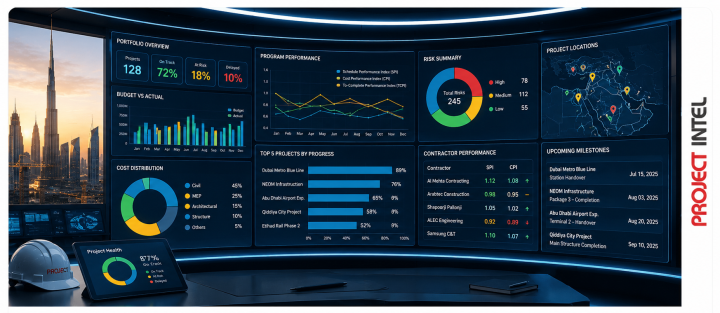
The Gulf Cooperation Council (GCC) continues to lead the world in delivering ambitious infrastructure and construction programmes. From smart cities and transportation networks to industrial developments and tourism destinations, governments and private developers are investing billions of dollars in projects that are transforming the region.
However, as projects become larger and more complex, traditional reporting methods are struggling to keep pace. Weekly Excel reports, disconnected systems, and static dashboards often provide only a snapshot of what has already happened rather than helping project leaders understand what is likely to happen next.
This shift is driving the adoption of Project Intelligence Platforms—solutions that combine project data, analytics, and actionable insights to support faster, more informed decision-making.
The Growing Complexity of GCC Construction Projects
Modern construction projects in the GCC involve multiple contractors, consultants, suppliers, government authorities, and stakeholders working simultaneously. Information flows from numerous systems, including scheduling software, ERP platforms, cost management tools, procurement applications, and site reporting systems.
When this information remains isolated, project teams face common challenges:
- Delayed decision-making due to fragmented reporting.
- Limited visibility into project risks.
- Inconsistent progress updates across stakeholders.
- Manual consolidation of reports consuming valuable time.
- Difficulty identifying issues before they affect cost or schedule.
As project portfolios expand, these challenges become increasingly difficult to manage using conventional reporting methods.
Why Dashboards Alone Are No Longer Enough
Dashboards have become standard in many organisations. They display project metrics, charts, and status updates in an accessible format.
While dashboards improve visibility, they often answer only one question:
“What has happened?”
Project leaders increasingly need answers to more strategic questions:
- Which projects require immediate executive attention?
- Where are schedule delays likely to occur?
- Which contractors are consistently underperforming?
- What risks could affect project completion over the next three months?
- How will current trends impact budgets and delivery milestones?
Answering these questions requires more than visualisation. It requires intelligence.
What Is a Project Intelligence Platform?
A Project Intelligence Platform brings together data from multiple project systems and transforms it into meaningful insights that support decision-making across the organisation.
Instead of simply presenting data, it helps organisations:
- Monitor project health in real time.
- Detect emerging risks early.
- Analyse trends across multiple projects.
- Improve executive reporting.
- Standardise performance measurement.
- Enable proactive rather than reactive management.
The objective is not to generate more reports—it is to enable better decisions.
Supporting Better Decisions Across Every Level
Different stakeholders require different perspectives on project performance.
Executives
Senior leadership needs a portfolio-wide view of organisational performance, strategic risks, financial exposure, and delivery confidence.
Project Directors
Project directors require detailed visibility into programme performance, resource utilisation, milestones, and contractor performance.
Project Controls Teams
Project controls professionals benefit from integrated schedule analysis, earned value metrics, cost tracking, and forecasting capabilities.
Site Teams
Construction managers need immediate visibility into site progress, issues requiring escalation, inspections, and outstanding actions.
A Project Intelligence Platform delivers the right information to each stakeholder without requiring multiple disconnected reports.
The Role of Artificial Intelligence
Artificial Intelligence is increasingly supporting construction organisations—not by replacing experienced professionals, but by helping them identify patterns that are difficult to detect manually.
Examples include:
- Predicting potential schedule delays.
- Highlighting unusual cost trends.
- Detecting recurring quality issues.
- Prioritising high-risk projects.
- Identifying procurement bottlenecks.
These capabilities allow project teams to respond earlier, reducing both financial and operational risks.
Why This Matters for GCC Organisations
Across the GCC, national development programmes continue to accelerate. Organisations are expected to deliver projects faster while maintaining transparency, governance, and accountability.
Digital transformation initiatives are encouraging the adoption of integrated platforms that improve collaboration across owners, consultants, contractors, and government agencies.
Project Intelligence supports these objectives by creating a single source of truth that enables stakeholders to work from consistent, reliable information.
Key Benefits of Project Intelligence Platforms
Organisations adopting Project Intelligence Platforms typically experience improvements in several areas:
- Faster executive decision-making.
- Improved project transparency.
- Earlier identification of project risks.
- Better coordination across multiple stakeholders.
- Reduced manual reporting effort.
- Improved confidence in project performance data.
- Enhanced governance across project portfolios.
- More effective communication between management and delivery teams.
These benefits become increasingly valuable as project portfolios continue to grow in scale and complexity.
Looking Ahead
The future of construction management is not simply about collecting more project data. Success depends on transforming data into actionable insights that help organisations make informed decisions before problems escalate.
For construction companies, consultants, developers, and government agencies operating across the GCC, Project Intelligence Platforms represent the next step in digital project delivery. They provide the visibility, consistency, and analytical capabilities needed to manage increasingly complex projects with greater confidence.
As the region continues to deliver some of the world’s most ambitious developments, organisations that embrace data-driven decision-making will be better positioned to deliver projects successfully, improve stakeholder confidence, and achieve long-term operational excellence.
Conclusion
The construction industry has already embraced digital reporting. The next evolution is intelligent reporting—where project information is connected, analysed, and transformed into decisions that improve outcomes.
Rather than asking “What happened?”, successful organisations are now asking “What should we do next?”
That shift marks the difference between a dashboard and a true Project Intelligence Platform.
About ProjectIntel
ProjectIntel is a modern Project Intelligence Platform designed to help construction organisations gain real-time visibility across projects, portfolios, and programmes. By bringing together project data, analytics, and executive reporting into a single platform, ProjectIntel enables faster decisions, improved governance, and greater confidence in project delivery across the GCC and beyond.